
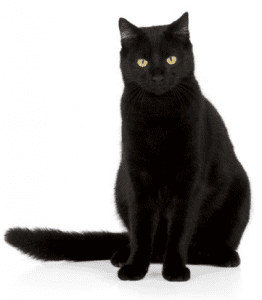
Black cat appreciation day!

Black catIn many cultures black cats are seen as good luck. Here in the US they’re sadly more associated with bad luck, and they have a hard time finding homes. Cats with black coat are nearly five times as likely to be put to sleep in a shelter than cats with another color.

Black cat appreciation day is intended to change the myths that keeps them from being adopted. Many people don’t understand cats. Some fear them, or even hate them, and keep spreading misinformation about them.

Not everyone has to like cats, but distancing oneself from a species because of myths and erroneous information is a loss both for the person and the cats.

Here are some fun facts about black cats:

  • According to the Japanese and the British, black cats are good luck
  • In Scotland, the black cat is believed to bring prosperity
  • Black cats are believed to be the best ship cats, because they bring good luck
  • Black cats are actually just like all other cats, except for being black. They’re just as sweet and cuddly as all other cats.
  • Black cats are like miniature panthers. They’re natural ninjas. Having a ninja panther is cool.

If you have a black cat, or adopt one, take some photos and share on social media. Together we can debunk the myth about black cats being bad luck!
Cormorant, Minnesota, has a new mayor: Duke the dog

Inhabitants of the small town of Cormorant, Minnesota, recently set out to vote. It was time to elect a new honorary mayor, and everyone could vote for whoever they wanted. Many thought the owner of the store would win, but he didn’t even have half as many votes as the victor.

Meet Duke, a 7 year-old who is surely the fluffiest mayor in the country. He won a landslide victory and celebrated with an extensive grooming session and a new outfit. He does get paid for the job; a local pet store donated a year’s supply of kibble.

//youtu.be/pJC–33ohUk

International Homeless Animals Day

Today is international homeless animals day and organizations around the world come together to inform about pet overpopulation. Today, you can count on seeing adopt-a-thons, spay/neuter clinics, microchip clinics, and many other activities. 

You might not think the situation is all that bad in the USA, but every year pet shelters are overrun by homeless cats and dogs. The sad consequence is that millions of pets are put down in shelters, often after just a couple of days. There are all sorts of pets in shelters. You can find pure bred dogs, mutts, cats, birds, rabbits, and even chickens. There are puppies and kittens as well as adult animals. Many are scared and confused, and don’t understand why their family isn’t there for them anymore.

If you’ve thought of adding a furry friend to your family, this might be a great day to do it. Go to your local shelter or visit petfinder.com to see available pets near you. Even if you don’t want or can’t commit to a pet, you can help by spreading information, sharing pets on social media, or bringing supplies to a local shelter or rescue.

National Check the Chip Day!

If you pet goes walkabout or is stolen, the chances of getting him or her back increases if the pet is microchipped. However, the chip only works if the registration information is correct. Check the Chip Day is created by AVMA – the American Veterinary Medical Association – and the AAHA – the American Animal Hospital Association.

To update your pet’s registration you need your pet’s microchip number. If you don’t already have an account with the manufacturer you need to do that as well, so you can update the information if something changes in the futures. It’s particularly important that your phone number and address are correct.

Most animal shelters and veterinarians will search a big database updated by the chip’s manufacturer. If you have your chip’s number, you can try to search it here to see if the information is correct: //www.petmicrochiplookup.org

Ever wonder how far away your cat goes?

The Cat Tracker is a new mapping project that encourages cat owners to put GPS collars on their cats in order to monitor their habits. The information can give new insight into cat behavior, and help conservationists save wildlife. Anyone in the USA, New Zealand, or Australia can participate. 

There are at least 95 million pet cats in the USA and millions more feral cats, and ecologists are concerned about their impact on wildlife.  The project will show whether cats in general kill wildlife routinely, or if just some cats engage in this. It can also help show whether cats that do kill and eat during their outdoor adventures have a higher incidence of parasites, and if these parasites are dangerous to humans.

The project will also track cats’ habits – some have been known to live with more than one household – and how large their areas are. A similar project tracked a cat with a home range of more than 1,300 acres. Does your cat stay close to home, or does he/she roam?

In order to participate in the program, the cat must be yours, and it needs to spend time both indoors and outdoors. Naturally, local leash laws must be observed.

If you want to learn more about the cat tracker project, click here!

How do you greet a dog?

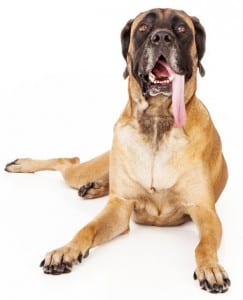
An English Mastiff requires an extra large PlexiDor dog doorAs much as we might want them to be, dogs aren’t human. Many incidents with dog bites could be avoided if everyone understood that we’re different. It’s tempting to greet a new dog like a new person or even a child, but not a great idea.

Many humans say hello to dogs they don’t know by bending over him or her and ruffling the top of the dog’s head. This might seem like a great idea to us, but to a dog it’s rude and might even be perceived as threatening.

Children tend to run up to dogs and try to pet their faces, accidentally poking the dog’s eyes, or want to hug the dog. This can cause the most well behaved and kind pooch to growl or even bite.

So, what should you do when meeting a new dog?

First of all, ask the owner’s permission to approach the dog. If he or she says no, accept it and move on. There might be many reasons why it isn’t a good time to make a new friend.

If the owner says yes, a good way to greet a dog is turning your body sideways, relaxing, and not staring. In doggie language, looking away is polite and staring means a challenge. Give doggie time to become curious and approach you.

If the dog comes up to sniff you, it is curious and interested. It might sniff you and pull back, and that means it wants some more space.

Many dogs are more comfortable if you crouch down with your side turned to him or her. Remember not to loom over the dog when you switch position between standing and crouching, and don’t stare. You want to come across as polite and friendly in doggie language.

Let the dog approach at its own pace. If it seems relaxed and comfortable – loose and wiggly body and relaxed eyes, ears and mouth – you can gently touch its side. If that goes well, pet its side. When you withdraw your hand you should be able to see if the dog wants more attention or not.

Sunshine story: Lady gets a new life

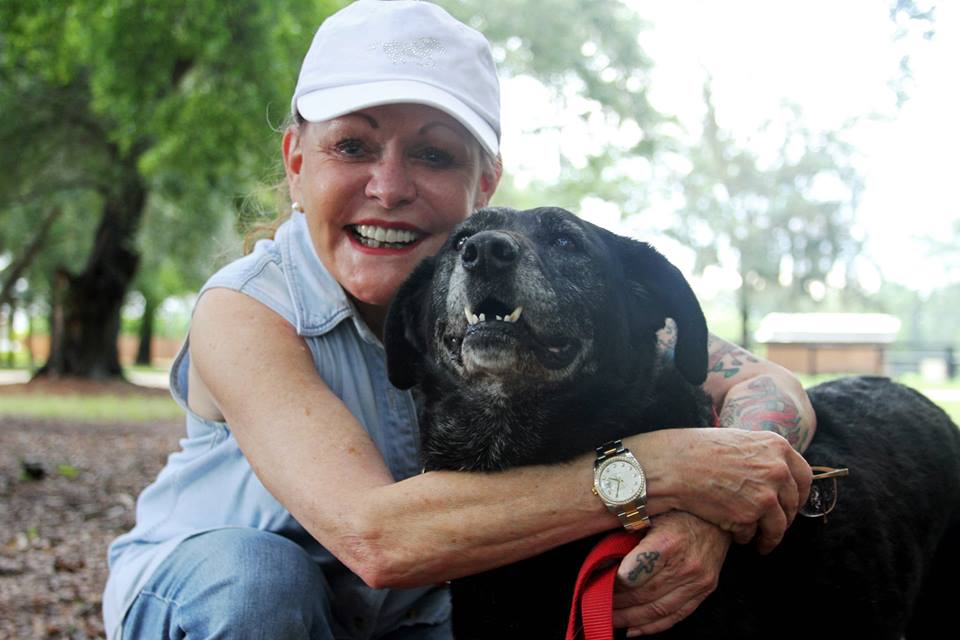
Lady is an elderly black lab who suffers arthritis. She ended up in a shelter in 2012 when her owner died, but she was adopted and everything seemed to work out okay. That is, until her new owners got another dog. Lady was promptly back at the shelter.

She wouldn’t have any of that. She walked 30 miles home to her family. Not a small feat since her arthritis make walking difficult. Unfortunately, they rejected her once more.

This could have been the end for Lady, but one of the volunteers posted about her on Facebook, and the heartbreaking story spread over the Internet all the way to Helen Rich, heiress to the Wrigley chewing-gum fortune. Ms Rich has had some hard turns in life herself and could sympathize with Lady. She promptly sent a private jet to pick up the dog!

Now Lady lives with Helen on a farm with seven other rescue dogs. Helen is also involved in the On the Wings of Angels initiative, helping innumerable dogs find homes.

Helen Rich and Lady
Helen Rich and Lady, image from the “On the Wings of Angels” Facebook page.

Children reading to shelter pets is a win-win scenario

dog smallMany children have problems reading. The school environment can be intimidating, and it’s no fun to constantly be corrected. At the same time, shelters are overcrowded with pets yearning for some human affection. The connection between reading problems and shelter pets might not be perfectly clear, but bear with us. It’s there.
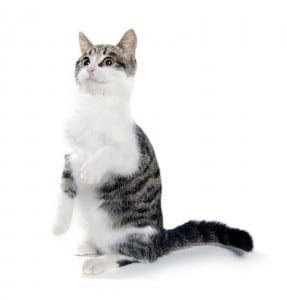
The children need practice and purpose in an environment that won’t judge them. The shelter pets need socialization and human interaction.

Turns out that children love to read to animals, and particularly cats are soothed by the rhythmic child voice.

Organizations around the country now offer programs where children are invited to read to animals. In many cases the same child comes back over and over again, and might even rehearse the story before presenting it to the pet.

These programs are particularly beneficial for many autistic children who find the animals a great source of support. Researchers at Tufts University claim the events lead to an increased use of language and improved social interactions.

Sunshine story: Hero cats protect their owners

There are many amazing stories about dogs saving people from everything from house fires to traffic accidents. Cats are more rarely featured in such news. Smudge is a hero cat who shows that cats do care about us, probably more than we know.

Smudge’s owner is Ethan; a five year old boy. Ethan played in the yard with his little brother when three other kids started picking on him, taunting him. His mother saw them from the house, and saw Ethan trying to ignore them.  One of the bullies pushed him to the ground and Ethan’s mom ran for the outside, but Smudge beat her to it.

The cat flew out from under the car and jumped on the bully’s chest. The boy stumbled backwards, burst into tears, and fled. Ever since then, Smudge sleeps by Ethan’s bedroom door, keeping guard.

Slinky Malinki is another hero cat who recently saved his owner. Slinky’s mom has a back problem and was prescribed morphine. No one knew that she had a strong reaction to the drug, and drifted in and out of consciousness for days.

Slinky did his best to get the neighbors’ attention. He tormented their dog and tapped on their windows until they realized something was wrong. Ever since, Slinky keeps a close eye on his human. If he doesn’t see her for a couple of hours he’ll go find her, and tap on her arm until she responds.

High-end homes with pet suites

Standard Pacific Homes is one of the nation’s largest home builders with around 190 communities around the USA. Building houses isn’t new, but some of the builder’s options are innovative.

The builder offers in-home pet suite and spa with everything from special storage for toys to easy-to-enter showers. The pet suites range from 50 square feet up to 170 square feet. The cost of the addition varies depending on size and area.

FOX 35 News Orlando

International Cat Day

CatToday is a good day to take some extra time to play with your cat – August 8th is International Cat Day, celebrating our feline friends. The day was first celebrated in 2002, and has become a yearly festivity.
Around the world, an estimated 500 million cats frolic in homes and gardens, regardless of country and climate. In the USA, there’s almost 100 million owned cats. Around 46 percent of US kitty-households have one cat, 31 percent share their home with two cats, and 24 percent have three or more cats.

Having a cat in the household has been proven to relieve stress, depression, and anxiety. Cats are particularly good for the heart – over a ten year period a cat owner is 30 percent less likely to die of a heart attack or stroke than a person without a cat. They may even lower the risk of cancer.

If you don’t already have a cat but you’ve been thinking of getting one, celebrate International Cat Day with going down to your local shelter and giving one a new home.

What’s up with cats and scratching furniture?

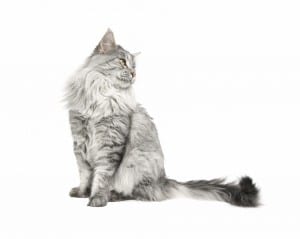
maine coon catCats love to scratch things. It removes the dead outer layer of their claws and keeps their claws sharp and conditioned. It’s a way for kitty to mark territory – cats have scent glands on their feet, and the scratching leaves a scent mark. Scratching also helps cats stretch while flexing their feet and claws.
Unfortunately, we humans don’t share the cat’s enthusiasm over scratching up the new sofa.

Observe in which rooms your cat likes to scratch, and on what. Then, substitute that object with something similar that’s okay for both you and the cat. For example corrugated cardboard, a log, or a carpeted post.

Cover the forbidden object in something cats don’t like, for example aluminum foil, cotton balls with perfume, or double-sided tape. Then, place the new and acceptable object close by.

Patience is key. Let your cat get used to the new acceptable object, and move it gradually – nor more than 1 inch every day – to a spot more suitable to you. The closer you can keep it to the cat’s preferred location, the bigger the chance this will work in the long run.

Keep the unappealing foil, tape, or cotton balls on the forbidden object until the cat has used the acceptable object in its right place for at least a month.

If you cat likes cat nip, looking for a scratching post with catnip hidden under the surface might help motivate him or her to use the “right” object for scratching.

Three myths about lost dogs

Lost dogs need help to get home to their families. If your dog wanders off, people might tell you some of these myths. It’s very important that you don’t believe them – keep looking for you dog! Some tips of what to do if your dog goes walkabout can be found here.

Myth One: Just wait for your dog to come home

Around 20 percent of lost dogs find their way back home, and it is a good idea to have someone at the house in case your pet shows up. However, the vast majority of lost dogs don’t come home on their own. That means you’ll never see him or her again if you don’t go out and look.

Myth Two: Old dogs go off to die

Old dogs wander off for many reasons. Intending to die alone is usually not one of them – lost old dogs who are found are generally extremely relieved to be found.

Elderly dogs often have diminished sight or hearing, they can be confused, have trouble with their balance, suffer a stroke, or have problems with their back legs and fall. They don’t mean to wander off any more than a human with dementia really means to leave home. If you have an older dog, always watch him or her.

Myth three: Your dog was killed by a Coyote

Over the past decade records on missing dogs show over 70 percent were found, and fewer than 3 percent were killed by coyotes. This myth is much more dangerous to dogs than any predator, because if people believe it, they stop looking. Almost any other explanation you can think of is more likely than your dog being killed by a Coyote.


Rescue dog tracks exotic species

Ten years ago black lab Tucker wandered the streets alone, afraid, and hungry. His prospects for the future were not bright; he was close to becoming one of the millions of homeless pets that die in shelters every year. Luckily for Tucker, he ended up with Conservation Canines, a unit of the University of Washington that employs dogs.

Tucker has an extraordinary sense of smell, and exemplary work ethic, and turned out to be very good at tracking scents so vague a human would never detect them. He has followed his handler all over the world, tracking Iguanas in the tropics, bats in old forests, and caribou in the arctic where he had to wear special boots and neoprene cape to withstand the cold. He can also track whales on light scents carried over water.

Tucker’s kennel mate Sadie went on a four month safari to Cambodia and helped determine how many tigers are left in two national forests.

Read more about Tucker in the Wall Street Journal

International Assistance Dog Week

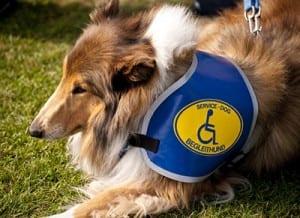
service dogThe International Assistance Dog Week is celebrated August 3 to August 9 2014. The event was created to celebrate all the devoted and hard working dogs that help individuals around the world every day.

The goals of the week is to recognize and honor assistance dogs, to raise awareness and educate, honor the trainers, and recognize heroic deeds performed by assistance dogs.

Assistance dogs can be pure bred or mutts. Many come from shelters. Regardless of size and color they all have one thing in common: they change the lives of their handlers and provide independence. They often make the difference between isolation and an active life. Examples of assistance dogs include Guide Dogs, Hearing dogs, and Service dogs.

These fantastic dogs can guide a blind handler safety through traffic, hear alarms, alert for seizures, and some are even trained to do household chores. They can learn to fetch items, pull a wheelchair, open and close doors, alert for high or low blood sugar, and a long number of other important tasks. Assistance dogs offer hope, dignity, and independence.

Don’t approach working dogs. Leave them alone to do their job. For company owners it is important to know that assistance dogs are allowed to accompany their humans to all places open to the general public – including restaurants and shops. While an assistance dog can wear an identifying vest, this is not a requirement.

To learn more about this week, visit assistancedogweek.org